
List Soft Skill
Soft skills — communication, teamwork, problem solving, adaptability — are what employers mean when they say “how you work”. This list explains 36 of them in plain words, gives a résumé bullet example for each, and lets you rate yourself to find your strongest areas. Pick your top skills and it builds a short skills section and matching bullet points you can adapt for your CV.
- Free to use
- No sign-up
- Runs in your browser
Soft skills finder and self-assessment
Soft Skills Career Pack
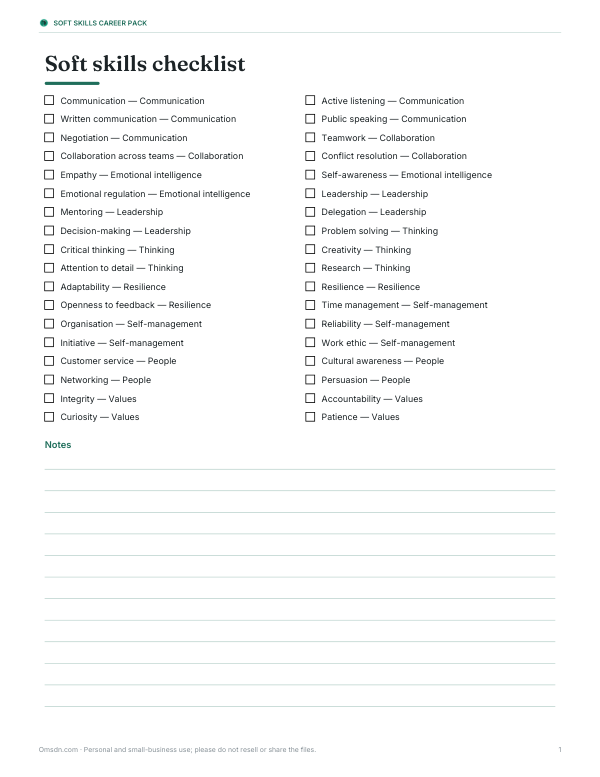
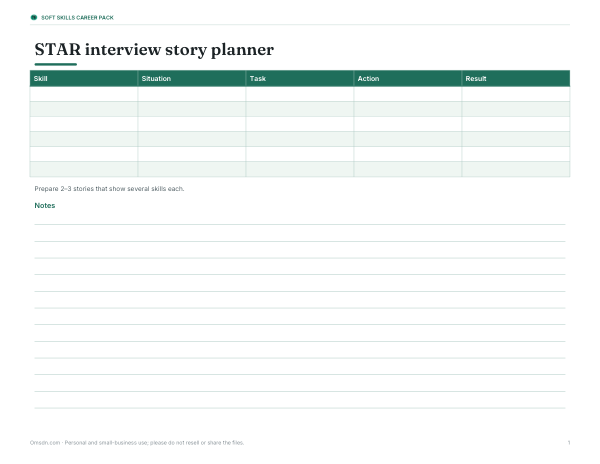
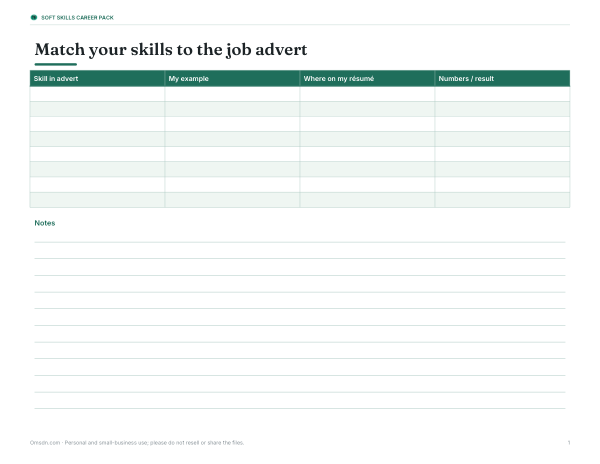
Printable soft skills checklist, a STAR interview story planner, a skills-to-job-advert matching worksheet and a feedback request form.
- Skills checklist (PDF/DOCX)
- STAR planner (PDF/DOCX)
- Advert matching (PDF/XLSX)
- Feedback form (DOCX/PDF)
Formats: PDF, DOCX, XLSX. Instant download after payment (link valid 72 hours, up to 5 downloads). AI-assisted: the templates were drafted with AI help and reviewed and laid out before publishing.
$5.00 USD, one-time 4 files · about $1.25 each
- Instant download
- 7-day refund
- Secure checkout by Stripe
7-day money-back guarantee. Full refund within 7 days of purchase, even after you download.
Free sample: Feedback Request Form (PDF, 71 KB)
Full refund within 7 days — see the refund policy and license.
Free printables
Single sheets you can print right now, no sign-up. The full pack adds every sheet in one download plus the editable files.
 Printable Feedback Request Form
Soft skills vs hard skills
Hard skills are specific, teachable abilities you can test — using spreadsheets, speaking Spanish, welding, coding in Python. Soft skills are how you work with people and handle tasks — communicating, cooperating, solving problems, managing your time. Employers look for both: hard skills show you can do the job; soft skills show how well you’ll do it with others. Many job adverts list soft skills such as “strong communication” or “works well under pressure” alongside technical requirements.
The full list
| Skill | Category | What it means |
|---|---|---|
| Communication | Communication | Explaining ideas clearly in speech and writing, and adjusting to your audience. |
| Active listening | Communication | Giving full attention, asking clarifying questions and reflecting back what you heard. |
| Written communication | Communication | Writing clear, concise emails, reports and documentation. |
| Public speaking | Communication | Presenting confidently to groups. |
| Negotiation | Communication | Reaching agreements that work for both sides. |
| Teamwork | Collaboration | Working well with others toward a shared goal. |
| Collaboration across teams | Collaboration | Coordinating with people outside your own team or function. |
| Conflict resolution | Collaboration | Handling disagreements calmly and finding solutions. |
| Empathy | Emotional intelligence | Understanding and considering other people’s feelings and perspectives. |
| Self-awareness | Emotional intelligence | Knowing your strengths, weaknesses and how you affect others. |
| Emotional regulation | Emotional intelligence | Staying calm and professional under pressure. |
| Leadership | Leadership | Guiding and motivating people toward a goal. |
| Mentoring | Leadership | Helping others develop skills and confidence. |
| Delegation | Leadership | Assigning tasks to the right people and trusting them. |
| Decision-making | Leadership | Weighing options and committing to a course of action. |
| Problem solving | Thinking | Identifying the cause of a problem and finding workable solutions. |
| Critical thinking | Thinking | Evaluating information and arguments carefully. |
| Creativity | Thinking | Coming up with new ideas and approaches. |
| Attention to detail | Thinking | Spotting errors and getting things right. |
| Research | Thinking | Finding, checking and summarising information. |
| Adaptability | Resilience | Adjusting to change and new situations. |
| Resilience | Resilience | Recovering from setbacks and keeping going. |
| Openness to feedback | Resilience | Accepting and acting on constructive criticism. |
| Time management | Self-management | Planning and prioritising to meet deadlines. |
| Organisation | Self-management | Keeping tasks, files and schedules in order. |
| Reliability | Self-management | Doing what you say you will, on time. |
| Initiative | Self-management | Acting without being asked when you see a need. |
| Work ethic | Self-management | Commitment to doing good work consistently. |
| Customer service | People | Helping customers and solving their problems courteously. |
| Cultural awareness | People | Working respectfully with people from different backgrounds. |
| Networking | People | Building and maintaining professional relationships. |
| Persuasion | People | Convincing others with reasons and evidence. |
| Integrity | Values | Being honest and acting ethically. |
| Accountability | Values | Taking responsibility for outcomes, including mistakes. |
| Curiosity | Values | Wanting to learn and understand. |
| Patience | Values | Staying calm and supportive when things take time. |
Showing soft skills on a résumé
- Pick three to six soft skills that match the job advert.
- Don’t just list them — prove them with an achievement in your experience section.
- Use numbers where you can: team size, time saved, customers helped.
- Mirror the words used in the advert so applicant tracking systems recognise them.
- Keep the skills section short; the evidence matters more.
Worked example
A job advert for a project coordinator asks for “excellent communication, organisation and problem-solving skills”. Instead of writing “Excellent communicator”, a candidate writes: “Presented weekly project updates to a 20-person team and wrote the client handover guide” (communication), “Organised a shared drive that the whole department now uses” (organisation) and “Diagnosed a recurring stock error and fixed the process behind it” (problem solving). The skills section then lists: Communication · Organisation · Problem solving.
Talking about soft skills in interviews
Interviewers often ask behavioural questions: “Tell me about a time you resolved a conflict” or “Describe a time you had to adapt quickly.” Answer with the STAR method — Situation, Task, Action, Result — and choose examples that match the skills in the job description. Prepare two or three stories that each show several soft skills, so you can adapt them to different questions.
Improving your soft skills
- Ask for specific feedback from managers, teachers or colleagues.
- Volunteer for tasks outside your comfort zone — presenting, leading a small project.
- Join clubs, teams or community groups.
- Take short courses in communication, negotiation or time management.
- Reflect regularly: what went well, what would you do differently?
Using the self-assessment
Rate each skill from 1 (still developing) to 5 (a real strength). The summary averages your ratings by category and lists the skills you rated 4 or 5. Click “Copy my skills section” to get a short skills line and matching résumé bullets you can edit. Ratings are saved only in this browser.
Career printables
The optional pack includes a printable soft skills checklist, a STAR interview story planner, a skills-to-job-advert matching worksheet and a feedback request form. The list and self-assessment above are free.
AI-assisted content
Definitions and example bullets were drafted with AI assistance and reviewed before publishing. Examples are illustrations — use your own real achievements.
Frequently asked questions
What are soft skills?
Personal and interpersonal abilities such as communication, teamwork, problem solving and adaptability.
What are the top soft skills employers want?
Communication, teamwork, problem solving, adaptability and time management are among the most requested.
How do I show soft skills on a résumé?
Prove them with specific achievements, not just a list.
What is the difference between soft and hard skills?
Hard skills are technical and testable; soft skills describe how you work with others and manage tasks.
Can soft skills be learned?
Yes, through practice, feedback and experience.
Are my ratings saved?
Yes, in this browser only.